Shenzhen Mufeng Technology Limited Company

Egg coding path: single-egg, tray, CIJ ink and food-grade TIJ
Upload Time:
Nov 09, 2026
A dealer path-and-SKU sheet for egg coding: MF-T2 single-egg, MF-T6 tray, JP-E78 CIJ egg ink, or food-grade TIJ for packaging beside the shell line.
By Shenzhen Mufeng Technology | Published (Asia/Shanghai)
An egg coding project is rarely one printer quote. Dealers and packing centres usually choose among a single-egg conveyor coder, a tray coder, a continuous inkjet (CIJ) station with egg ink, or a food-grade thermal inkjet (TIJ) path for packaging that sits next to the shell line. This guide deepens the existing egg coding machine guide with a path-and-SKU decision sheet. It uses live MufengTech product pages for MF-T2, MF-T6, JP-E78 egg blue ink, and the TIJ food-grade cartridge.
Shenzhen Mufeng Technology, established in 2012, supplies industrial inkjet equipment and consumables under MufengTech. Treat every speed, head count, and ink claim below as a confirmation checklist, not a fixed shipment promise.
Start with the mark location, not the machine name
Ask where the code must appear and how the egg is handled at that moment:
- Directly on each eggshell, one egg at a time on a holed conveyor.
- On eggs that stay in plastic or pulp trays, row by row.
- On eggs already moving through an existing Hitachi-family CIJ grading or packing line.
- On food packaging next to the egg line (cartons, labels, secondary packs), not on the shell itself.
Those four answers map to different SKUs. Mixing them in one vague “egg coder†enquiry is the fastest way to get the wrong fixture, ink, or head count.
Record the required date, best-before, farm/packer code, and brand mark. MF-T2 and MF-T6 pages position egg coding around traceability and regulatory marking, but they do not publish a universal legal template for every country. Confirm the string layout with the customer’s compliance owner.
Path A — Single-egg conveyor with MF-T2
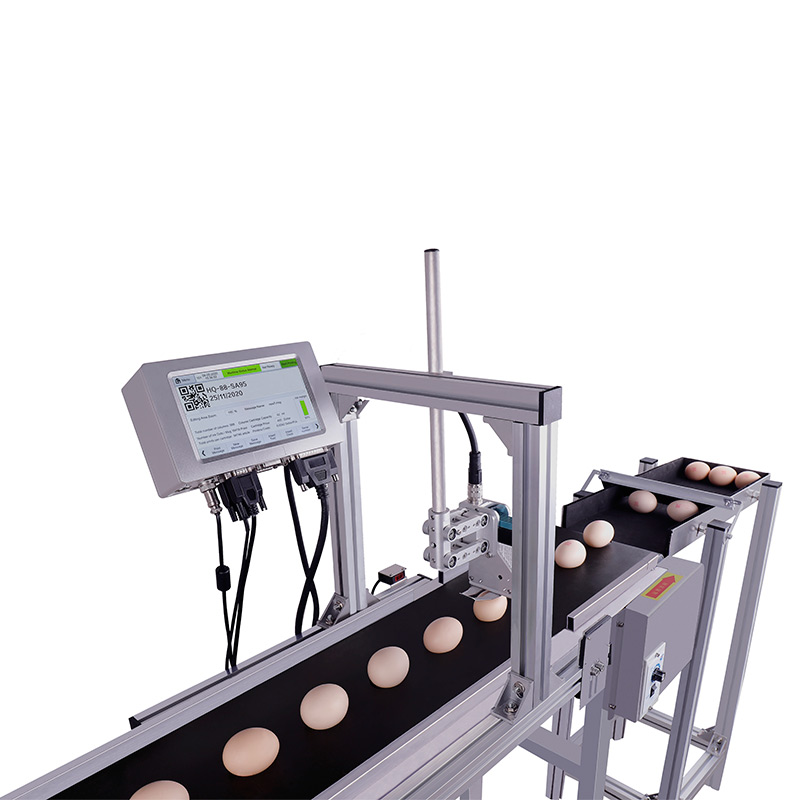
Choose the MF-T2 egg coding and marking solution when operators can place eggs into reserved holes in a conveyor belt and print one shell at a time. The published workflow is: eggs sit in belt holes, travel at a set speed, a sensor triggers the print, and the code lands on the shell surface. Because the egg is fixed, the page states that top, middle, or bottom print positions can be selected.
Published MF-T2 notes include conveyor speed regulation of 5–28 m/min, conveyor size 1500 mm × 250 mm × 750 mm (200 mm belt), and controller size 202 mm × 119 mm × 61.2 mm. The page also lists anti-collision rebound components and a recycling tray concept. Confirm fixture height, sensor placement, and recovery handling before promising output.
Path B — Tray coding with MF-T6
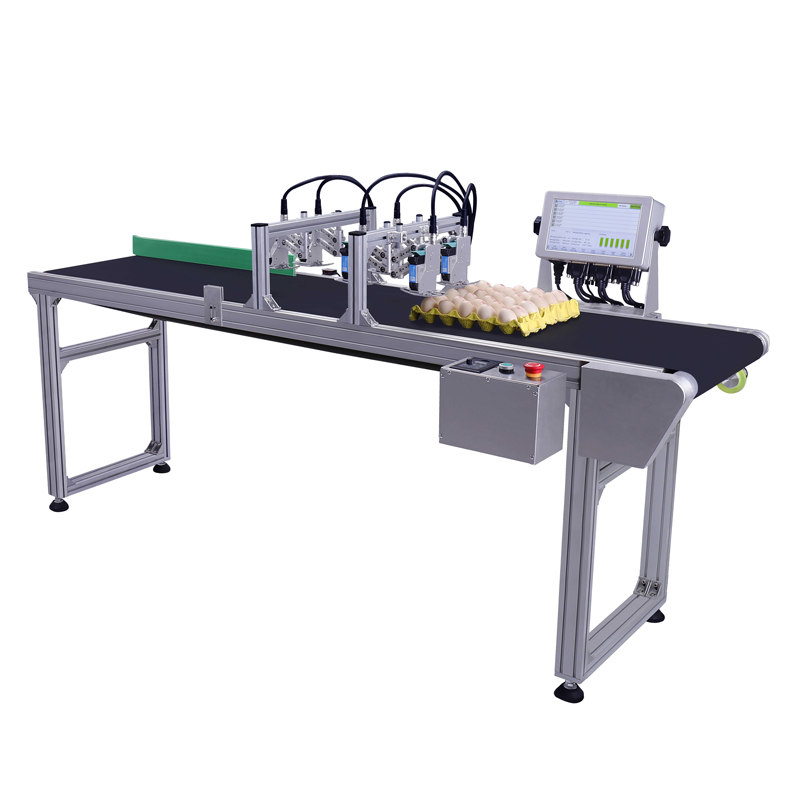
Choose the MF-T6 egg coding and marking solution when eggs should stay in the tray. The published workflow moves the whole tray on a conveyor; when the sensor detects the tray, print heads mark horizontal rows in sequence. The page states that operators can select 1–6 print heads to match tray type or placement direction, and that plastic or pulp trays such as 2×5 or 5×6 layouts can be conveyed and printed.
Published MF-T6 notes include stepless conveyor speed 0–60 m/min, conveyor size 2000 mm × 460 mm × 750 mm (400 mm belt), and controller size 274 mm × 165.4 mm × 88 mm. Confirm head count, bracket layout, and tray sample before treating the six-head maximum as the commercial offer. Prefer MF-T6 when eggs should stay in trays; prefer MF-T2 when single-shell orientation matters more than tray throughput.
Path C — CIJ egg ink on an existing Hitachi-family line
If a Hitachi-family CIJ station already exists, start with ink pairing. JP-E78 egg blue ink is listed as ethanol-based, food-grade blue ink for Hitachi PB, PXR, RX, RX2, and UX printers, with high contrast on white and brown eggshells. Price and lead time are on request. Brand names identify intended printer families; they are not a licence to mix unrelated OEM fluids. Confirm printer model, current fluid code, and shell samples before shipping. See also the egg coding category.
Path D — Food-grade TIJ for packaging next to the egg line
Secondary cartons and labels often need packaging coding rather than shell contact. The TIJ food-grade cartridge page lists model 3MFPK201, magenta, 42 ml, with 12.7 mm and 25.4 mm print-height entries and a 6-month warranty note, for food packaging surfaces and production traceability. Do not invent FDA/EU certificate numbers absent from the public page—request current documents for the intended contact condition. Keep shell and packaging coding on separate enquiry lines. Broader machine routing: food packaging coding dealer checklist.
Decision table for dealer and OEM quotes
| Path | Typical need | Live SKU / page to open first | Confirm before quoting |
|---|---|---|---|
| Single-egg TIJ-style conveyor | Precise mark on each shell in a holed belt | MF-T2 | Belt holes, print position, 5–28 m/min range, recovery tray |
| Tray coding | Eggs stay in plastic/pulp trays | MF-T6 | Tray type (e.g. 2×5 / 5×6), 1–6 heads, 0–60 m/min range |
| Existing Hitachi CIJ line | Shell codes without a new dedicated egg conveyor | JP-E78 egg blue ink | Printer series, current fluid code, white/brown shell samples |
| Packaging beside the egg line | Carton / pack traceability, not shell contact | TIJ food-grade 3MFPK201 | Substrate, contact claim docs, 12.7 vs 25.4 mm cartridge |
Build one qualification pack before samples
Collect for every path: marked photos of white/brown eggs or packs; code content and language; volume, spacing, and cold/condensation conditions; preferred path (MF-T2, MF-T6, CIJ ink, food-grade TIJ); and any existing printer/fluid codes. Dedicated egg pages emphasise food-grade egg ink themes such as definition, adhesion, quick drying, and anti-condensation—still require a sample acceptance record on the real product.
Send a path-specific enquiry to MufengTech
Email frank@szmufeng.com or WhatsApp +86 158 1405 1051 with path letter (A–D), photos, code content, and preferred SKUs. Ask for written configuration, ink confirmation, and a sample plan. Do not publish lead times, stock promises, or certificate numbers until confirmed. Keep linking the egg coding machine guide for the broader overview.
Frequently asked questions
Is MF-T2 or MF-T6 the default egg coding machine?
Neither is a universal default. MF-T2 fits single-egg holed-belt coding; MF-T6 fits tray coding with a selectable 1–6 head layout. Choose from the handling method first.
Can JP-E78 replace a dedicated MF-T2 or MF-T6 system by itself?
Only when a suitable Hitachi-family CIJ printer is already on the line and the shell mark can be produced there. JP-E78 is an egg blue ink consumable path, not a complete conveyor fixture package.
Does the TIJ food-grade cartridge automatically cover eggshell printing?
The public food-grade cartridge page focuses on food packaging surfaces and production traceability. Shell projects should start from the dedicated egg solutions and egg ink pages, then confirm any TIJ packaging marks separately.
Where should dealers start if they already read the November egg guide?
Use this path-and-SKU sheet to shortlist MF-T2, MF-T6, JP-E78, or food-grade TIJ, then return to the egg coding machine guide for the broader process explanation.
Relevant News


Contact Us
16th floor Building AB South Securities Building, Luohu District Shenzhen


