Shenzhen Mufeng Technology Limited Company

Egg Coding Machine Guide: How to Print Dates on Eggs
Upload Time:
Nov 03, 2026
An egg coding machine prints dates, batch and traceability codes directly on each eggshell with food-grade ink. Compare single-egg conveyor coding, tray coding and CIJ egg ink, and choose in 6 steps.
By Shenzhen Mufeng Technology Limited Company | Published
An egg coding machine prints production dates, best-before dates, batch numbers and traceability codes directly on each eggshell, using food-grade ink that is safe for direct contact with food. Choose a single-egg conveyor coder for precise marks on individual eggs, a tray coder to mark whole trays without unpacking, or a CIJ printer with egg ink to add coding to an existing grading line.
This guide from Shenzhen Mufeng Technology Limited Company explains why eggs are coded, how our two egg coding solutions work, what makes egg printing ink different, and gives a 6-step method to choose the right egg date printer for your farm or packing centre.
What is an egg coding machine?
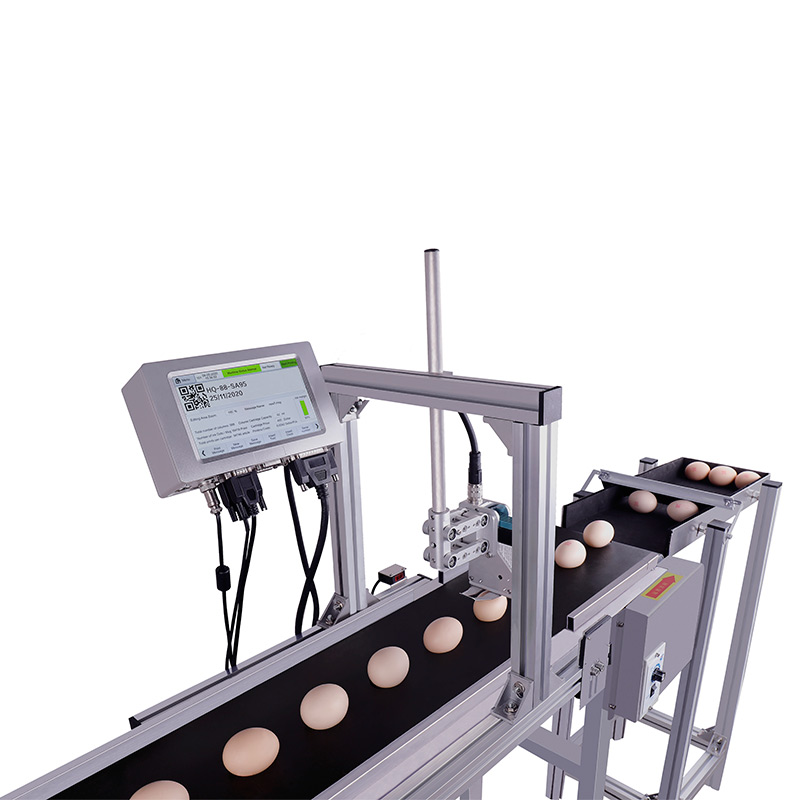
An egg coding machine is an inkjet printing system built to mark information on the curved, fragile surface of an eggshell. It combines a conveyor that holds the eggs steady, a sensor that detects each egg or tray, an inkjet print head and a dedicated egg ink.
Typical content is the production date, best-before date, farm or batch code, and sometimes a brand logo. Because eggs vary in size and curvature, the machine must hold each egg in position and protect the shell while it prints.
Why egg traceability coding matters
Egg traceability coding links each egg to its origin, processing and sale. Many countries have rules for marking eggs, and exporters must meet the requirements of the destination market as well as their own.
A clear code also helps consumers. When the production and best-before dates are on the shell, buyers can judge freshness and quality, and a printed brand mark helps your eggs stand out from unmarked ones.
Egg coding machine options: comparison table
| Factor | MF-T2 single-egg conveyor coder | MF-T6 tray coder | CIJ printer with egg ink |
|---|---|---|---|
| How eggs are handled | Each egg sits in its own hole in the conveyor belt | Whole trays travel on the conveyor; eggs stay in the tray | Printer added to your existing grading or packing line |
| Print trigger | Sensor detects each egg | Sensor detects each tray | Photocell on your line |
| Print heads | One printer | 1 to 6 print heads, chosen by tray type | Depends on the printer model |
| Conveyor speed | Electronic regulation, 5 to 28m/min | Stepless regulation, 0 to 60m/min | Matched to your line |
| Conveyor size | 1500 x 250 x 750mm, 200mm belt | 2000 x 460 x 750mm, 400mm belt | Not applicable |
| Trays | Eggs roll into a collecting tray after printing | Plastic or pulp trays, 2x5 or 5x6 | Not applicable |
| Best for | Accurate marks on the top, middle or bottom of each egg | Batch coding of whole trays without unpacking | Lines that already handle and orient eggs |
MF-T2: single-egg conveyor coding
The MF-T2 egg coding and marking solution places each egg in a reserved hole in the conveyor belt. The eggs move forward at a set speed, and when the sensor detects an egg, the code is printed on its surface. Because the egg is fixed, you can choose to print on the top, middle or bottom of the shell.
An anti-collision rebound component adjusts the height to the curvature of each egg and protects the shell. After printing, a buffer device slows the eggs down and they fall into a collecting tray automatically. The machine runs on 220V, 50Hz, with an embedded Linux system and an industrial-grade FPGA main control chip.
MF-T6: whole-tray egg coding
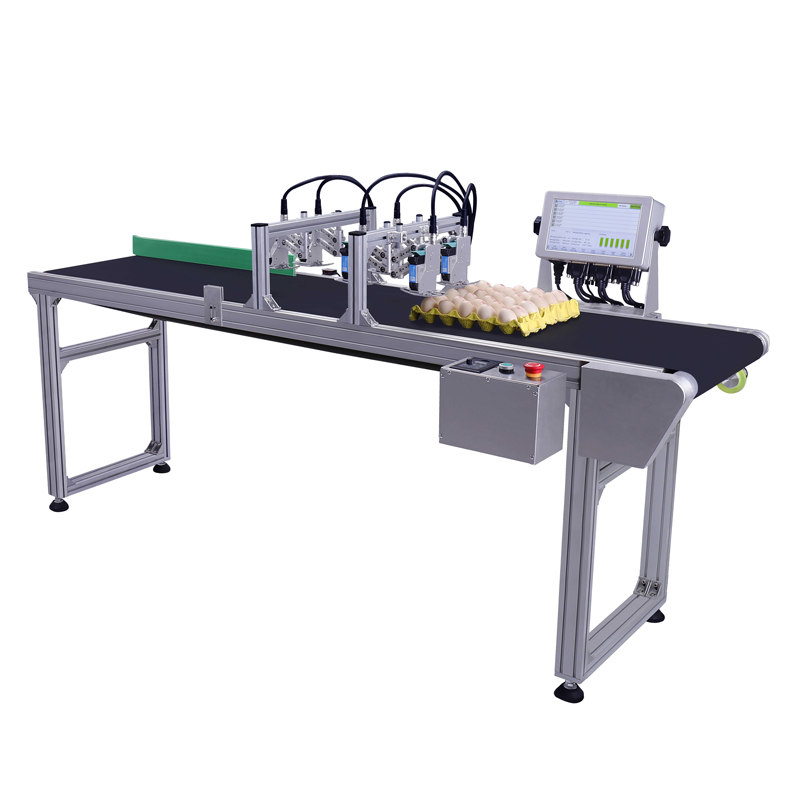
The MF-T6 egg coding and marking solution codes eggs while they are still in the tray. The whole tray travels on the conveyor, and when the sensor detects it, the print heads mark each row of eggs in turn. You can choose between 1 and 6 print heads to suit the tray type and direction.
It handles plastic or pulp trays in 2x5 or 5x6 layouts. The conveyor uses stepless variable-frequency speed regulation from 0 to 60m/min, so it can follow the speed at which trays are loaded. This avoids taking eggs out of the tray and speeds up batch coding.
Egg printing ink: what makes it different
Egg printing ink is a food-grade ink made for direct contact with the shell. The ink used with our egg coding solutions is designed for:
- High definition and contrast on the eggshell surface
- Low diffusion, so the code stays sharp as the shell changes naturally over time
- High adhesion in humid and harsh conditions
- Quick drying, to avoid smudging and keep the line moving
- Anti-condensation, so print quality holds when eggs move from cold storage to a warmer room
If you already run a continuous inkjet line, the JP-E78 egg blue ink is an ethanol-based, food-grade blue ink for Hitachi PB, PXR, RX, RX2 and UX CIJ printers, made for high contrast on both white and brown eggshells. Our MFS200 Plus series CIJ printer also offers edible egg ink among its ink options.
How to choose an egg date printer in 6 steps
- Define the code. List the content: production date, best-before date, farm or batch number, and any logo. Check the rules in each market you sell to.
- Check how eggs arrive. Loose eggs suit a single-egg conveyor such as the MF-T2. Eggs already in trays suit the MF-T6. Eggs on an existing grading line may suit a CIJ printer.
- Count your volume. Estimate eggs or trays per hour and compare with the conveyor speed range of each solution.
- Check tray types. For tray coding, note the material (plastic or pulp) and layout (2x5 or 5x6).
- Check shell colour and storage. Tell us whether your eggs are white or brown, and if they come from cold storage, so we can match the ink.
- Test on real eggs. Send us your requirements and, where possible, we will test print quality before you order.
For more on CIJ printers and egg inks, see our specialised site cijinkjet.com egg coding.
About Shenzhen Mufeng Technology Limited Company
Shenzhen Mufeng Technology Limited Company was established in Shenzhen in July 2012. We combine independent research and development, production, sales and after-sales service, with more than 120 professional technicians and a plant area of over 10,000 square metres. Our inkjet coders, laser marking machines and consumables are used by customers around the world.
FAQ: egg coding machines
Is egg coding ink safe to eat?
The ink used with our egg coding solutions is a food-grade ink designed for direct contact with the eggshell. Confirm the ink type for your market and printer with our team before ordering.
Can an egg coding machine print on brown eggs?
Yes. Egg inks are chosen for contrast on the shell; the JP-E78 egg blue ink, for example, is made for high contrast on both white and brown eggshells.
Can I code eggs without taking them out of the tray?
Yes. The MF-T6 tray coder marks whole plastic or pulp trays (2x5 or 5x6) on the conveyor, with 1 to 6 print heads.
How fast is an egg coding machine?
The MF-T2 conveyor runs at 5 to 28m/min and the MF-T6 conveyor at 0 to 60m/min. Actual output depends on egg spacing and tray loading.
How do I get a recommendation?
Contact Shenzhen Mufeng Technology Limited Company on WhatsApp +86 158 1405 1051 with your code content, egg volume and tray type.
Need help choosing? Send your code content, egg volume and tray type on WhatsApp +86 158 1405 1051 and our team will recommend an egg coding solution.
Relevant News

Contact Us
16th floor Building AB South Securities Building, Luohu District Shenzhen


