Shenzhen Mufeng Technology Limited Company

Laser Marking vs Inkjet Coding: Which Should You Choose?
Upload Time:
Nov 02, 2026
Laser marking vs inkjet coding: lasers make permanent, ink-free marks; inkjet coders print fast, flexible codes on almost any surface. Compare materials, consumables and speed, and choose in 6 steps.
By Shenzhen Mufeng Technology Limited Company | Published
Laser marking vs inkjet: choose a laser marking machine when the code must be permanent and you want no ink or solvent at all, for example on metal parts, plastics or glass. Choose an inkjet coder when you need flexible, high-contrast codes on many different surfaces at low set-up cost, such as cartons, bottles, bags and cables.
This guide from Shenzhen Mufeng Technology Limited Company explains how each technology works, compares them in one table, describes the fiber, CO2 and UV laser options, and gives a 6-step method to choose the right coding and marking system for your products.

What is laser marking?
Laser marking uses a focused laser beam, steered by mirrors, to change the surface of the product. Depending on the material, the beam removes a thin coating, changes the colour of the surface or engraves it slightly. No ink touches the product, so the mark cannot smear and there are no fluids to refill.
The laser source must suit the material. Our laser marking machines mark at speeds up to 18,000mm/s, with a minimum line width of 0.02mm and a standard marking area of 50 to 300mm. They import DXF, PLT, AI, PNG, JPG and BMP files for logos and graphics.
What is inkjet coding?
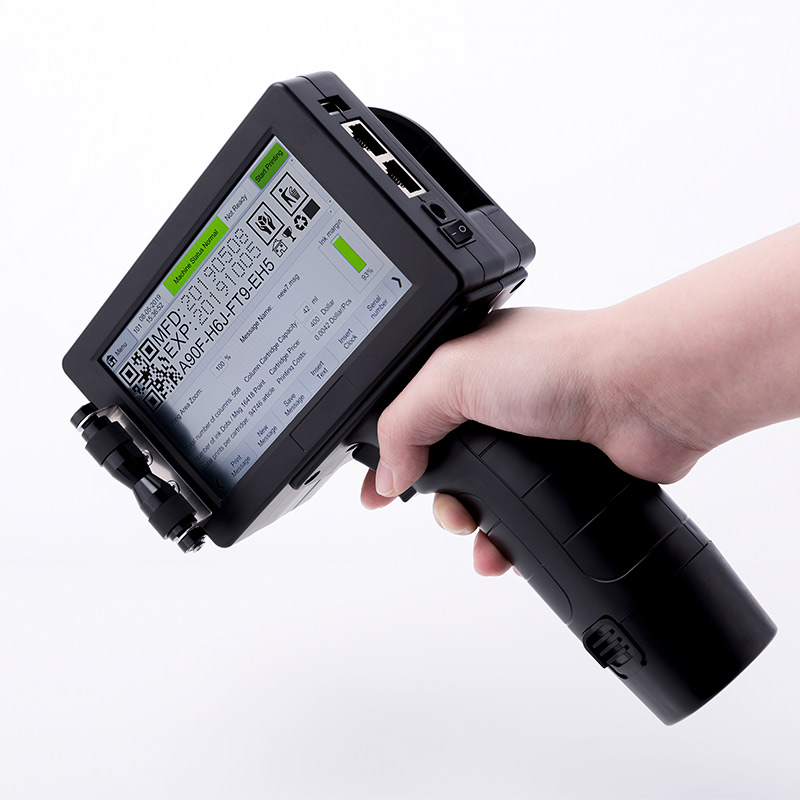
Inkjet coding sprays tiny ink drops onto the product without contact. There are two main types. A thermal inkjet (TIJ) coder prints from a cartridge with a built-in head, at up to 600DPI and 12.7mm or 25.4mm per head. A continuous inkjet (CIJ) printer prints small characters from an ink reservoir onto fast-moving or curved products.
Because the ink sits on the surface, you can choose the ink for the job: water-based for cartons, solvent quick-drying for plastics and metal, pigmented white or yellow for dark surfaces, and food-grade inks for food packaging.
Laser marking vs inkjet: comparison table
| Factor | Laser marking machine | Inkjet coder (TIJ or CIJ) |
|---|---|---|
| How it marks | Laser beam changes or removes the surface | Ink drops printed onto the surface |
| Permanence | Permanent; cannot be wiped off | Depends on ink and surface; good adhesion with the right ink |
| Consumables | None; no ink or solvent | Cartridges (TIJ) or ink and make-up solvent (CIJ) |
| Contrast | Depends on the material; some materials give low contrast | High contrast with a suitable ink colour |
| Materials | Fiber: metals. CO2: plastics, glass, paper and other non-metals. UV: fine marks on non-metals with low heat input | Almost any surface with the right ink: cartons, film, plastic, metal, glass, cables, eggs |
| Speed | Up to 18,000mm/s marking speed; depends on content and material | CIJ up to 528m/min (MF-M2000) or 576m/min (MFS2000) line speed |
| Typical uses | Metal parts, electronics, plastic housings, glass, serial numbers and logos | Expiry dates, batch codes, barcodes and QR codes on packaging lines |
| Set-up | Higher machine investment; safety guarding for the laser beam | Lower entry point; handheld TIJ coders need almost no installation |
Fiber, CO2 or UV: which laser marking machine?
If you choose laser, the next question is which laser source. Each wavelength suits different materials:
- Fiber laser (1064nm). The MF-LF fiber laser marking machine comes in 20W to 80W versions with dual red-light positioning and air cooling. It is used for metal: stainless steel, aluminium and other metal parts.
- CO2 laser (10.6, 10.2 or 9.3 micrometre). The MF-LC CO2 laser marking machine comes in 30W and 60W versions with air or water cooling. It is used for plastics, glass and non-metal materials, including paper-based packaging.
- UV laser (355nm). The MF-LU UV laser marking machine comes in 3W, 5W and 10W versions. Its reduced thermal effect gives fine, high-precision marks on non-metal materials.
When inkjet coding is the better choice
An inkjet coder is usually the better fit when your line codes many different products and materials, when you need dark, high-contrast codes, or when you want a low entry cost.

For cartons and small batches, a handheld coder such as the MF-G100 handheld inkjet machine prints 1 to 12.7mm high codes with no installation. For bottles, cans, cables and pipes on fast lines, a CIJ printer such as the MF-M2000 high stable CIJ inkjet printer prints 1 to 4 lines at up to 528m/min with IP65 protection.
Laser marking vs inkjet: how to choose in 6 steps
- Define the mark. Is it a date and batch code that changes every day, or a permanent serial number, logo or part number?
- Identify the material. Metal points to a fiber laser. Plastics, glass and paper point to CO2 or UV laser, or to inkjet with the right ink. Cartons and porous materials usually suit inkjet.
- Check contrast needs. If the mark must be dark and easy to read on a light or printed surface, test both. Some materials give a weak laser mark.
- Consider consumables. Laser needs no ink or solvent. Inkjet needs cartridges, or ink and make-up for CIJ, but lets you change ink type and colour.
- Check line speed and layout. Note the line speed, the size of the code and how the product passes the marking head.
- Test on samples. Send product samples or photos to our team. We can recommend a laser or inkjet model and test where possible.
Can I combine laser and inkjet?
Yes. Many factories laser-mark permanent part numbers on components and use inkjet coders for dates and batch codes on the outer packaging. Each technology then does the job it is best at.
For more detail on inkjet options, see our specialised sites: tijinkjet.com for TIJ cartridges and coders, and cijinkjet.com for CIJ printers, inks and laser marking machines.
About Shenzhen Mufeng Technology Limited Company
Shenzhen Mufeng Technology Limited Company was established in Shenzhen in July 2012. We combine independent research and development, production, sales and after-sales service, with more than 120 professional technicians and a plant area of over 10,000 square metres. Our inkjet coders, laser marking machines and consumables are used by customers around the world.
FAQ: laser marking vs inkjet coding
Is laser marking better than inkjet?
Neither is better for every job. Laser marking gives permanent, ink-free marks and suits metal parts, plastics and glass. Inkjet coding gives flexible, high-contrast codes on almost any surface at a lower entry cost and suits packaging lines.
Does a laser marking machine need ink?
No. A laser marking machine changes or removes the surface of the product, so it uses no ink, solvent or cartridges.
Which laser marking machine is best for metal?
A fiber laser marking machine (1064nm) is used for metal. Our MF-LF series comes in 20W to 80W versions.
Can a CO2 laser mark plastic and glass?
Yes. CO2 laser marking machines such as our MF-LC series are used for plastics, glass and other non-metal materials. Results depend on the material, so test samples first.
How do I get a recommendation?
Contact Shenzhen Mufeng Technology Limited Company on WhatsApp +86 158 1405 1051 with your product, material, mark content and line speed.
Need help choosing? Send your product, material and mark content on WhatsApp +86 158 1405 1051 and our team will recommend a laser or inkjet solution.
Relevant News


Contact Us
16th floor Building AB South Securities Building, Luohu District Shenzhen


